
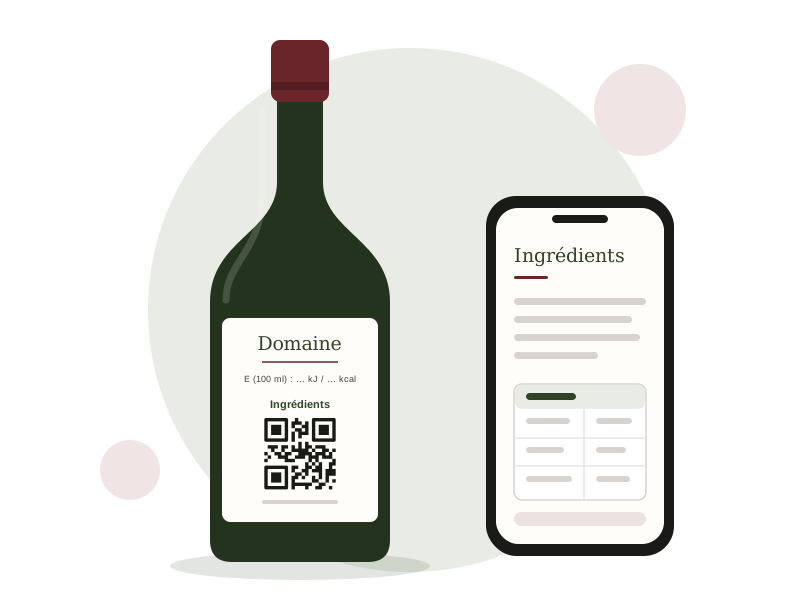
In brief: Wines produced from December 8, 2023, must indicate their list of ingredients and nutritional declaration. The paper label can refer, via a QR code, to an online page that provides this information: this is the electronic label (or e-label). The energy value and allergens must remain on the paper label, and the online page must contain only regulatory information.
1. Which Wines Are Affected?
The rule comes from the European CMO Regulation (Regulation (EU) 1308/2013, amended by Regulation (EU) 2021/2117). It applies to wines produced from December 8, 2023, sold within the European Union, including imported wines:
- still wines, sparkling wines, liqueur wines;
- dealcoholized or partially dealcoholized wines;
- aromatized wine products.
"Produced" does not mean "bottled." According to the European Commission, a wine is produced when it meets the conditions of its category: for a still wine, when it has reached its alcoholic strength and acidity; for a sparkling wine from secondary fermentation, when that fermentation is complete. The bottling date does not count.
In practice, the 2024 vintage is the first fully affected vintage, and wines produced before December 8, 2023, can be sold without these details until stocks are depleted. For a 2023 vintage or a wine without a vintage (such as a blend), it is up to you to verify when the wine was produced: the vintage alone is not sufficient proof.
2. What Must Be Indicated?
Two new pieces of information:
- The list of ingredients, with allergens highlighted (such as sulfites).
- The nutritional declaration for 100 ml: energy value in kJ and kcal, then fat, saturated fatty acids, carbohydrates, sugars, protein, and salt. When a value is very low, the mention "negligible amount" is possible, within the limits provided by the presentation rules.
The values must be accurate for the wine in question. For a sweet wine or a sparkling wine, they are calculated based on its actual sugar content.
3. What Must Remain on the Paper Label
The QR code allows the label to be streamlined, but not emptied. The following must remain on the bottle:
- the energy value for 100 ml, in kJ and kcal, preceded by the letter "E";
- allergens;
- all other mandatory information, which does not change (sales designation, alcoholic strength, volume, origin, bottler, lot, pregnant woman logo, etc.).
The QR code must:
- be in the same visual field as the other mandatory information (a sticker is acceptable if placed there);
- be accompanied by a word indicating its content, typically "Ingredients" above the code. According to the European Commission, the "i" symbol alone is not sufficient;
- be distinct from any marketing QR code: if you want to direct to your shop or social networks, use a different code elsewhere on the label.
Its size is not fixed, but it must be legible: test it with your printer. Written mentions, for their part, measure at least 1.2 mm.
4. What the Online Page Must (and Must Not) Contain
The page opened by the QR code:
- provides the ingredients and nutritional declaration of the specific wine. A single page can serve multiple wines only if their ingredients and nutritional values are identical; otherwise, one page per wine (or even per vintage if the composition changes);
- is free, without an account and without registration;
- displays in the language of the countries where the wine is sold;
- contains no advertising, no commercial content, and no links to a shop;
- does not collect visitor data or track them (no advertising trackers or nominative statistics).
One often overlooked point: the page must remain online as long as your bottles are in circulation, which can be for years. Most providers operate on an annual subscription basis, with a QR code that goes through their service: check how long the page remains online if you cancel the subscription. An address on your winery's domain name avoids this dependency.
5. Selling Online: Information Before Purchase
On an online store, the customer cannot scan the bottle before purchasing. Regulation (EU) 1169/2011 (Article 14) therefore requires that the ingredients and nutritional declaration be accessible on the wine's product page before ordering, free of charge:
- either directly on the page, for example in a "Mandatory Information" block;
- or via a visible and direct link to the wine's electronic label, without an account or fee.
Do not rely on the QR code on the bottle for this. The product page must also provide other details from Article 119 of the CMO Regulation: sales designation, alcoholic strength, nominal volume, country of origin, bottler or producer, allergens, and for affected wines, sugar content. For wines without PDO or PGI, add the price per liter.
6. You Have a Showcase Site Without Sales
If your site presents your wines without selling them, the electronic label is not mandatory there: the obligation applies to the bottle. However, you can still publish it, as it is useful for your customers.
Be careful, however: a page that presents a wine may be considered advertising for an alcoholic beverage. The Évin Law (Article L. 3323-4 of the French Public Health Code) then limits what the page can say (origin, composition, production method, terroir, distinctions, characteristics of color, smell, and taste, etc.) and requires the message "Abuse of alcohol is dangerous for health."
7. The Most Common Mistakes
A 2024 survey by the consumer association CLCV of 85 wines found non-compliance in 20% of wines with QR codes, or one in five. The most common issues:
- the link does not work (or no longer works);
- the word "Ingredients" is missing next to the code;
- the list of ingredients is incorrect or incomplete;
- the page mixes regulatory information with commercial content;
- the page only exists in French when the wine is sold abroad.
Before printing, scan the code with two different phones and review the page as a customer would.
Frequently Asked Questions
Is my 2023 vintage affected?
It depends on the date it was produced (see §1), not its vintage. A still wine whose fermentation was completed before December 8, 2023, is not affected; verify this for each cuvée.
Can I put the entire nutritional declaration on the label instead of a QR code?
Yes. The QR code is an option, not an obligation. In this case, the label must be translated into the language of each country of sale.
Is the "i" symbol next to the QR code sufficient?
No, according to the European Commission: a word indicating the content, typically "Ingredients," is required.
Can I put a link to my shop on the electronic label page?
No. The page contains only regulatory information. Use a different QR code for your shop.
Are wines sold only at the cellar affected?
Yes: the obligation applies to the bottle, regardless of the place of sale.